In this video, Dr. Lamont Tang discusses the nature of the intersection between mental excellence and disturbance. To what extent is genius and mental illness (such as bipolar disorder and schizophrenia) related? To what extent do genetics and environment influence genius and mental illness? Do we as a society overestimate and overemphasize the value of intelligence?
 There are a number of life transitions and changes that may occur as a person ages. These can include adult children moving out of the home, retirement, change in financial status, death of spouse, moving to assisted living, and so on. In an effort to deal with these stresses some seniors turn to gambling as a coping method. This serves as an important reminder for anyone working with seniors to inquire about problematic gambling behaviours the same way in which questions are asked around alcohol and substance use.
Check out this short article for a list of straightforward questions we can all ask to determine whether an underlying gambling disorder may be present: http://globalnews.ca/news/1798353/problem-gambling-can-be-an-issue-for-seniors/ 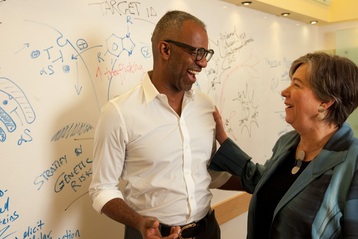 Yumanity CEO Tony Coles, who sold Onyx Pharmaceuticals to Amgen in 2013, is starting a new company that will use yeast to try and discover new treatments for Parkinson’s, Alzheimer’s, and amyotrophic lateral sclerosis (ALS).
“We’ve got 50 million people around the world suffering from these diseases, $650 billion in economic costs, and lots of families like mine that have been affected,” says Cole. In all of these disorders, proteins that play important roles in the brain become mis-folded. When these mis-folded proteins are put into yeast cells, they die. The first step is to find drug compounds that keep the yeast cells from dying. These are then put into human neurons derived from induced pluripotent stem cells created from people who have the disease. If the drug seems effective in human cells, it is then put back into yeast to try and figure out what molecular target it affects. By this back-and-forth approach (yeast, then human, then yeast, then human again) it may be possible to find and understand new drugs for the disease. http://www.forbes.com/sites/matthewherper/2014/12/15/biotech-entrepreneur-tony-coles-takes-aim-at-parkinsons-and-alzheimers/  "No One Brings Dinner When Your Daughter Is An Addict" is a short but powerful read about a family coping with both cancer and addiction, and the drastic differences they noticed in the ways in which those around them treated, talked about and provided support for a physical illness vs a mental illness ...
"Friends talk about cancer and other physical maladies more easily than about psychological afflictions. Breasts might draw blushes, but brains are unmentionable. These questions are rarely heard: “How’s your depression these days?” “What improvements do you notice now that you have treatment for your ADD?” “Do you find your mnic episodes are less intense now that you are on medication?” “What does depression feel like?” “Is the counseling helpful?” A much smaller circle of friends than those who’d fed us during cancer now asked guarded questions. No one ever showed up at our door with a meal." 
"Anxiety in preschoolers may lead to physiological changes in the brain, a recent study suggests... The study showed there was weaker connectivity in the brains of these children between the prefrontal cortex and the amygdala, two regions that interact to play an important role in regulating anxiety...The study reaffirms the notion that having a mental illness is not simply "all in a sufferer's head" or a "phase" -- even when it comes to children."
This should draw our attention to the reality that mental illness, as with many physical illnesses, can begin as early as childhood. It also brings questions to the forefront about our education system and how we cope with social anxiety and withdrawal in children. Read through the comments section for a more personal perspective of those who have struggled with anxiety since childhood. Read more: http://www.huffingtonpost.com/2015/02/04/preschool-anxiety-study_n_6605912.html  Once there was a great forest fire, and all the birds and animals rushed to escape. Hummingbird went to the river and collected a drop of water. The other birds laughed. “What are you doing?” They asked. She replied, “I’m doing what I can." -Native American Story Sufferers of depression and suicidal thoughts often report feeling like Hummingbird... they can carry only a droplet of water, and the fire is everywhere. They feel helpless and therefore unable to deal with the weight of their depression. And it gets worse. The topic of depression and suicidal ideation has been freshly brought to public awareness with stunning story of Blake Robert's expulsion from residence at Acadia University this past Thursday. Where can depressed teens and young adults turn for help if their admission of a problem to an authority figure is rewarded with the destruction of their social network in the ostensible interest of the greater good? The answer seems to be to fight against depressive feelings and present a publicly-acceptable face to the world around us. To hide how we really feel. Sami Moukaddem, clinical psychologist, recounts the stark reality of his own lifetime battle against depression and suicidal thoughts in an excellent TED talk and posits that the key to battling depression isn't to fight against it, but to openly embrace it and seek to understand the reason it exists within us. 
An engaging tedtalk that uses personal anecdotes to illustrate how an individuals perceptual field, and expansions and contractions within that perceptual field, dictate the decisions we make. Through his descriptive account of his multiple experiences with suicide, Mark Henick explains why people do not "commit suicide"
https://www.youtube.com/watch?v=D1QoyTmeAYw&app=desktop  A new study has demonstrated a positive correlation between taking high doses of anticholinergic medications for prolonged periods of time and dementia risk. This class of medication includes commonly used diphenhydramine (Benadryl), tricyclic antidepressants, and oxybutynin which is often used to treat bladder incontinence. "The study ... is the first to link higher use of anticholinergic medications to increased risk of dementia. It is also the first to suggest that the dementia risk associated with these drugs may not be reversible even years after people stop taking them." As such, "health care providers should regularly review their older patients' drug regimens -- including over-the-counter medications -- to look for chances to use fewer anticholinergic medications at lower doses."
To read more about this topic, visit http://www.cbsnews.com/news/common-allergy-depression-meds-may-increase-odds-of-dementia/ |
Description
Supporting and enhancing students' and health professionals' knowledge and understanding of mental health and psychiatry
Archives
June 2017
Categories
All
|


 RSS Feed
